Wednesday morning, half a frozen banana wedged sideways against the blade, and my old $90 blender just — hummed. Stalled. I finished that smoothie with a fork, which is not a sentence I ever expected to type about kitchen equipment.
That was around the point I stopped trusting box copy and started keeping an actual spreadsheet (I own a Vitamix Ascent, a KitchenAid Pro 5 Plus, and enough All-Clad to throw a dinner party — the lid on that All-Clad sauté pan still has a dent from a bad Tuesday two winters ago, but that's a different article). I bought the Vitamix A3500 two Black Fridays ago for $549, down from $699, and it's the one that runs most mornings now. Every number below is pulled straight off each manufacturer's own current spec page rather than my memory of a forum thread from three years back, because some of these numbers move without anyone announcing it. The Blendtec I used to point people toward here, the Designer 725, isn't even sold anymore — it's been replaced by the Designer 650, so that's what's sitting in the table now.
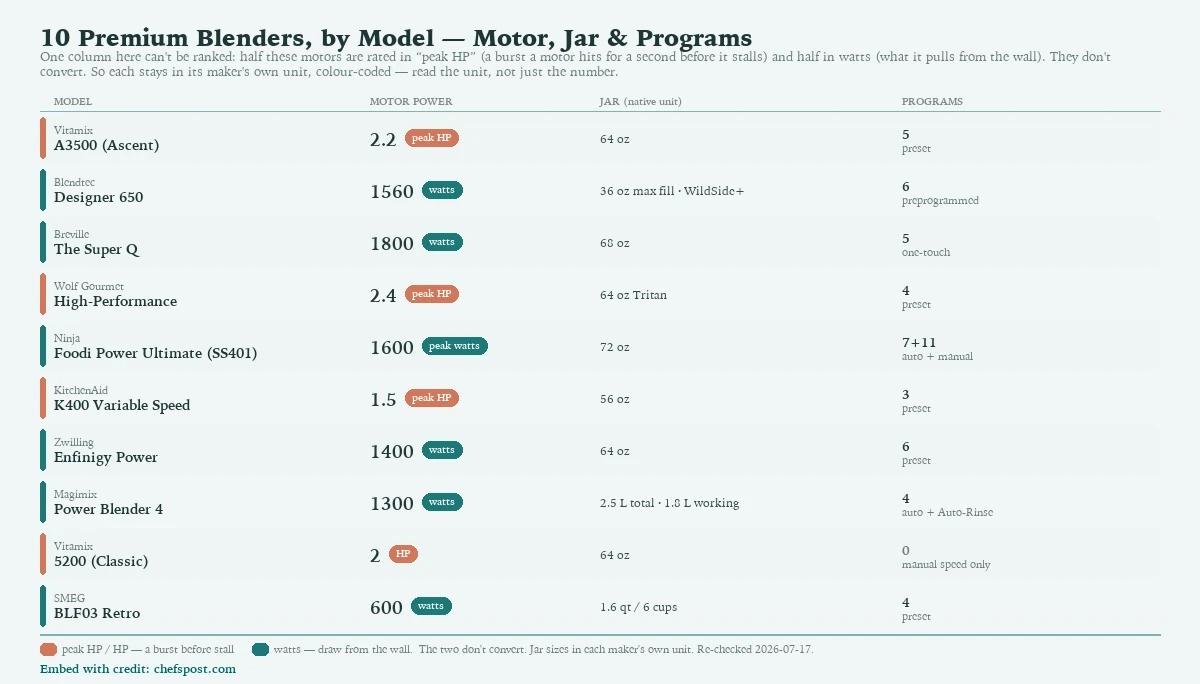
Premium Blender Technical Comparison Table
| Model | Motor Power | Jar Capacity | Pre-set Programs |
|---|---|---|---|
| Vitamix A3500 (Ascent Series) | 2.2 Peak HP [1] | 64 oz | 5 (Smoothies, Hot Soups, Dips & Spreads, Frozen Desserts, Self-Cleaning) |
| Blendtec Designer 650 | 1560 Watts [2] | 36 oz max fill, WildSide+ jar [3] | 6 (Sauces & Batters, Ice Crush & Margarita, Smoothie, Ice Cream, Whole Juice, Hot Soup & Fondues) |
| Breville The Super Q | 1800 Watts [4] | 68 oz | 5 one-touch (Smoothie, Green Smoothie, Frozen Desserts, Soup, Pulse/Ice Crush) |
| Wolf Gourmet High-Performance Blender | 2.4 Peak HP [5] | 64 oz | 4 (Smoothie, Ice Crush, Puree, Soup) |
| Ninja Foodi Power Blender Ultimate (SS401) | 1600 Watts (Peak) [6] | 72 oz | 7 automatic + 11 manual programs |
| KitchenAid K400 Variable Speed Blender | 1.5 Peak HP [7] | 56 oz | 3 (Ice Crush, Icy Drink, Smoothie) |
| Zwilling Enfinigy Power Blender | 1400 Watts [8] | 64 oz | 6 pre-set programs (incl. Smoothie, Crush Ice, Frozen Desserts) |
| Magimix Power Blender 4 | 1300 Watts [9] | 2.5 L total / 1.8 L working | 4 automatic programmes (Crushed Ice, Smoothies, Soups, Frozen Desserts) + Auto-Rinse |
| Vitamix 5200 (Classic) | 2 HP [10] | 64 oz | 0 (Manual Variable Speed Control) |
| SMEG BLF03 Retro Style Blender | 600 Watts [11] | 1.6 qt / 6 cups | 4 (Smoothie, Green Smoothie, Ice-Crush, Auto-clean) |
Terminology and Measurement Standards
- Peak Horsepower (HP)
- A measurement of the maximum output a motor can produce for a short duration before stalling. This figure represents the motor's potential power rather than its continuous operational output during blending.
- Wattage
- The measure of electrical power consumed by the motor. While higher wattage often correlates with higher torque, efficiency in blade design and airflow also impacts actual blending performance.
- Total vs. Blending (Max Fill) Capacity
- Total capacity refers to the volume of the jar if filled to the brim. Blending capacity (or "max liquid fill") is the volume the manufacturer recommends staying under to prevent overflow during high-speed use. For example, the Blendtec WildSide Flow Jar has a 90 oz total capacity but a recommended max liquid fill of up to 40 oz [12].
- Pre-set Programs
- Automated cycles that vary speed and duration to achieve specific textures. These typically include "Pulse" functions for manual control and cleaning cycles that use water and a drop of soap at high speed to dislodge debris.
The purchase I regret out of everything on this list: the SMEG BLF03, in the pale blue that matches basically nothing else in my kitchen except my own poor judgment at checkout. I bought it for looks and had it in my head that it ran an 800-watt motor — it's actually 600 watts, and that gap shows up the second frozen fruit goes in. Fine for a smoothie. Not fine for much else. It lives in a cabinet now.
Who each end of this table is actually for: if you make one smoothie on a normal morning and the occasional soup, the KitchenAid K400 or the Wolf Gourmet blender is plenty — save the couple hundred dollars and don't let anyone talk you into a Vitamix for a once-a-day habit. If you're running a blender daily for a whole household — weekday smoothies, a Sunday batch of soup for the freezer, ice for a crowd — the extra money in the A3500 or the Blendtec Designer 650 buys you a motor that isn't straining, which in my experience is the actual thing that kills cheaper blenders early, not some vague quality gap. The Magimix Power 4 is the one I point European readers toward, since the wattage and capacity numbers check out and the motor guarantee runs 30 years, longer than I plan on keeping this kitchen.
This mostly tracks with what comes up on r/cooking every time this question gets asked, and with Wirecutter's testing too, though the exact wattage and capacity figures shift slightly whenever a manufacturer quietly updates a model — which is exactly why I re-check the source page instead of trusting a number I wrote down two years ago.
Last verified: 2026-07-17
Sources
- [1] Vitamix: A3500 Ascent Series Specifications
- [2] Blendtec: Designer 650 Product Page
- [3] Blendtec: WildSide+ Jar Product Page
- [4] Breville: The Super Q Product Page
- [5] Wolf Gourmet: High-Performance Blender Product Page
- [6] Ninja Kitchen: Ninja Foodi SS401 System
- [7] KitchenAid K400 Variable Speed Blender: Manufacturer specifications (Amazon listing)
- [8] Zwilling Enfinigy Power Blender: Manufacturer specifications (Amazon listing)
- [9] Magimix: Blender Power 4 Product Page
- [10] Vitamix: 5200 Legacy Bundle Specifications
- [11] SMEG: BLF03 Retro Style Blender (Black) Technical Sheet
- [12] Blendtec: WildSide Flow Jar Product Page