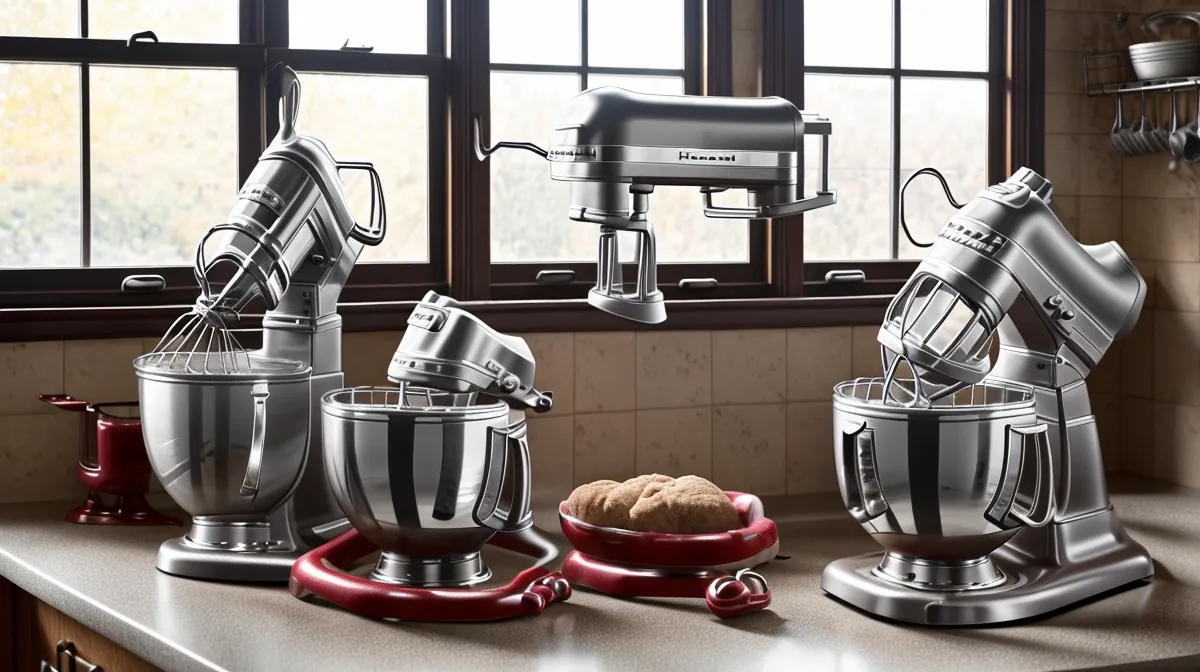
Flour dust has worked its way into the seam where the bowl locks onto a KitchenAid Pro 5 Plus stand mixer, a fine gray line a towel won't fully lift anymore. That's the kind of mark a stand mixer earns after enough weekly sourdough bakes to matter, and it's why I don't trust a review of one that hasn't actually kneaded real dough.
Quick housekeeping before the flour talk: some of the links below, including ones to ShopKitchenAid, Vitamix, and All-Clad, are affiliate links, and I earn a commission if you buy through one at no extra cost to you. I only link to gear that's actually gone through real use in my kitchen, not something I unboxed once for a photo.
I'm Hannah, a freelance copy editor who spends the day fixing other people's commas and the rest of it arguing with dough. My kitchen currently holds a KitchenAid Pro 5 Plus stand mixer, a Vitamix Ascent, enough All-Clad to cover a full dinner party without borrowing a single pan, and a Pyrex bowl that hasn't left the counter in years, starter or no starter. I buy bread flour a few pounds at a time from Willy Street Co-op on Willy Street, which has given me plenty of chances to notice which tools actually hold up between grocery runs and which ones quietly turn into clutter. A friend of mine spends her weekends restoring mid-century modern furniture in her garage, sanding one chair rail at a time until it's right, and testing kitchen gear scratches roughly the same itch for me: slow, repetitive, occasionally maddening.
The Day My Tilt-Head Started Walking Across the Counter
My first serious stand mixer was a KitchenAid Artisan (pistachio green, which felt like a bold choice at checkout and mostly just showed every flour handprint), bought during the same spring everyone else in Madison seemed to be baking bread for the first time. For cookies, cakes, and the occasional bowl of whipped cream, it did everything I asked. Then I got serious about sourdough — pushing hydration up toward 75 and 80 percent, doing double batches of bagels on Saturday mornings, the whole thing.
One Wednesday night a few years back, I genuinely thought the Artisan was going to walk itself right off the counter. The tilt-head was bouncing hard enough during a ten-minute knead that I had to lean on it with one hand just to keep it in place. That's the moment you find the ceiling on entry-level premium gear. Sourdough is a heavy, resistive beast, and it doesn't just need a spinning hook — it needs a frame that won't give.
It's not the motor, it's the hinge. Every time a dough hook catches a stiff mass of flour, it pushes up against that locking pin, and over enough loaves the pin loosens and the whole head starts to rock. Once you're working with true high-hydration sourdough, that hinge becomes the whole problem. A tilt-head simply wasn't built to fight a dough that fights back.
Why Bowl-Lift Beats Tilt-Head for Heavy Sourdough Dough
That bowl-lift design changes everything: instead of the head tipping back on a hinge, the KitchenAid Pro 5 Plus bowl sits on two arms you crank upward with a lever. It feels less like a countertop appliance and more like a small piece of shop equipment, and at around 25 pounds it hasn't shifted an inch from its spot since the day I set it there. It also costs meaningfully more than the tilt-head Artisan line, and most of that gap doesn't announce itself until your third or fourth winter of weekly sourdough, once the bowl-lift frame is still dead quiet under a stiff dough and an Artisan would already be walking. I've tested the larger 7-quart and 8-quart commercial-style bowls too, and my contrarian take is that unless you're running an actual micro-bakery out of your house, the 5-quart is the better size — a single loaf's worth of dough just gets chased around the bottom of a bigger bowl instead of getting worked against the sides. Which size and model actually makes sense depends on whether you're an occasional-cookie baker or someone doing this every week, and that split is the whole subject of my Best KitchenAid Mixer for Home Bakers Choosing Between Premium Models breakdown.
What Dough Development Actually Looks Like Under the Hook
Dough development is really just gluten organizing itself under stress. Flour proteins tangle into a loose net the moment water hits them, and kneading is what pulls that net into aligned, stretchy sheets instead of a shaggy clump. A tilt-head mixer can technically do this, but it loses steady contact with the bowl wall under a stiff dough, so parts of the mass get worked while other parts mostly just sit there. KitchenAid's planetary design is the reason a bowl-lift model does this more evenly: the hook spins on its own axis while it also orbits the bowl, hitting 67 touch points per revolution instead of tracing one lazy circle. That's the difference between dough that develops evenly all the way through and dough with a dense, underworked core that only shows up once you slice into the loaf.
No rip anywhere near the edges — that was the first time I pulled a truly clean windowpane off the hook, around the eight-minute mark, stretching a golf-ball piece of dough thin enough to see my fingers through it before it finally gave. I held it up and turned it around like I'd won something, which is a ridiculous way to react to a piece of dough. By the fourth week of running the Pro 5 Plus through weekly bakes, checking the dough by feel instead of the clock had become routine instead of a special occasion — I stopped setting a timer for kneading at all and just started pulling pieces off the hook to look.
The Gear Cluster: What Else Lives in the Kitchen
A stand mixer earns its keep by being more than a dough machine. My husband Joel and I run a standing Sunday pasta night, and that's where the attachment ecosystem stops being a gimmick — the same motor that kneads eighty-percent-hydration sourdough will roll linguine thin enough to see through. I was skeptical of the pasta roller for a solid year before I actually tried it, and now it's the accessory I reach for most after the dough hook itself; how far you push that accessory box before a dedicated pasta machine makes more sense is genuinely its own question, one I keep meaning to test properly. It's the same logic I apply to my Vitamix — if a tool costs this much, it needs to do more than one thing exceptionally well, and a blender only proves that after months of actual daily use, not a first-week honeymoon, which is the whole premise behind my long-term Ascent notes.
High-end gear also tends to show up in clusters. I hear a faint metallic ring the second a cold All-Clad pan touches the grate on my gas burner, and that kind of heat retention is exactly what I dug into in Best Stainless Steel Cookware Sets After Testing Premium Brands — mass matters in a pan the same way it matters in a mixer's base. Lately I've added a Magnifique claypot to the rotation. I still reach for cast iron on the heaviest crusts, but the claypot has turned out to be the right call for a slow-cooked stew on a Sunday when the oven's already running hot for bread, and it performs closer to the expensive French brands than its price tier would suggest, as long as you're not cooking on induction.
The same pattern holds everywhere else in the kitchen. A good chef's knife keeps its edge through daily prep long enough that you stop thinking about it, right up until it doesn't, which is a separate rabbit hole from whether a sharpening stone or a pull-through is the better fix once it dulls. A silicone spatula that can sit against a hot pan without softening earns its spot on the hook; the ones that can't end up in a drawer, unused. Getting the right Vitamix container matched to the batch size you're actually blending matters more than people expect, the same way a wireless meat thermometer only pays for itself if you're roasting something you can't afford to guess on. Even something as small as a silicone mat under a tray of cookies changes how evenly the bottoms brown. None of that is sourdough, but it's the same underlying question every time: does the tool perform once you've stopped paying attention to it.
From Mixer to Oven: Finishing the Loaf
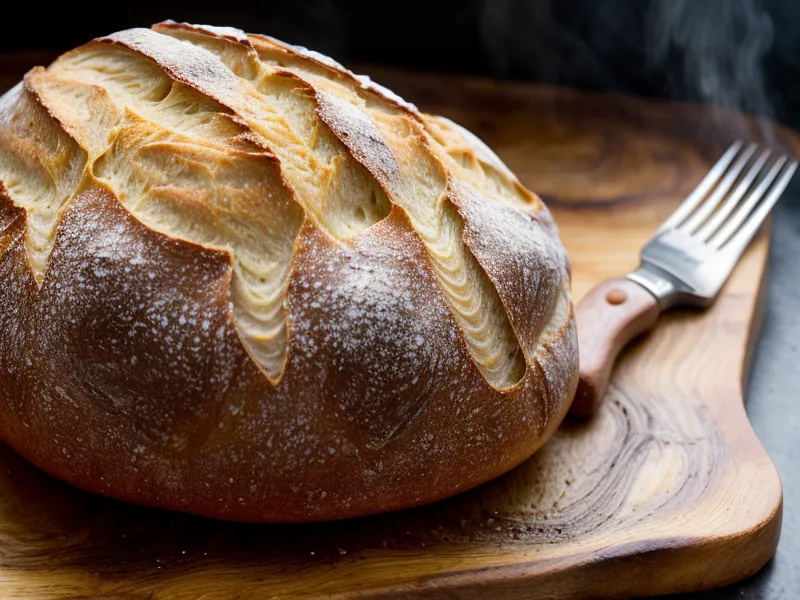
Once the Pro 5 Plus is done kneading, the loaf goes into my Challenger Breadware pan — the mixer builds the dough's strength, but the pan is what actually builds the crust. I've tried Lodge Dutch ovens and the pricier Le Creuset pots, and neither beats the Challenger for one specific reason: the rectangular footprint, which lets a long batard sit flat instead of getting cramped against round walls. The longer version is in Best Bread Pan for Sourdough After Using the Challenger Breadware, but the short version is that a side-by-side bake — same dough, same oven, one loaf in each pan — gave the Challenger loaf a visibly more open crumb and a crust that shattered instead of just crackling. It's around 22 pounds of cast iron, which makes it a genuine two-hand lift in and out of a hot oven, but if you're already committed to hauling a 25-pound mixer across your counter, that's not the part that's going to change your mind.
Who Should Buy the Pro 5 Plus — and Who Shouldn't
This mixer is not for everyone, and pretending otherwise would be dishonest. If baking for you means an occasional batch of chocolate chip cookies, stick with an Artisan or even a hand mixer — you don't need to give up a foot of counter space for something you'll touch twice a year. If you're in a small apartment and would have to store it in a lower cabinet, the weight alone will make you resent it within a month; hauling 25 pounds out from under a counter for a Tuesday loaf gets old fast.
Not every upgrade I've made has worked out this well. A T-fal nonstick set I bought around the same time warped on my gas burner by month four, no matter how carefully I preheated it, and it sat unused for the better part of a year before I finally admitted it wasn't coming back flat. The mixer wasn't that kind of purchase.
Buy the Pro 5 Plus if you bake sourdough or a heavy rye at least once a week, if you're tired of chasing a tilt-head across the counter mid-knead, if you actually plan on using the pasta or grinder attachments instead of letting them sit in a box, or if you like the idea of owning something that'll still be worth roughly 60% of its price on the resale market a decade from now. If none of that describes your kitchen, save the counter space and the money for something you'll actually reach for every week — the KitchenAid Pro 5 Plus only earns its keep if sourdough is a habit, not an aspiration.