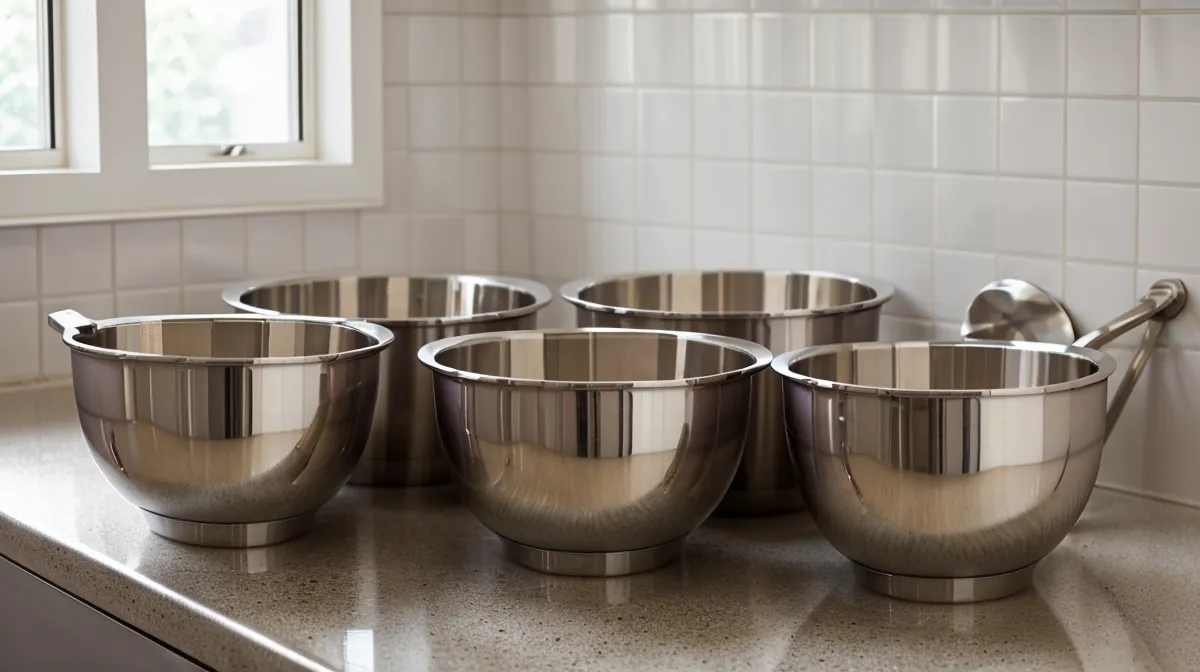
How much does a stainless steel mixing bowl actually need to weigh before it stops migrating across your counter the second you start whisking with any real force? Nobody answers that on the product page, and it's the question that separates a set of kitchen prep gear you'll keep using from one that ends up nested at the back of a cabinet by month three.
A programming note before the technical stuff: several of the products below — Vitamix, All-Clad, KitchenAid — are linked through affiliate programs, and if you buy through one of those links I earn a small commission at no extra cost to you. I only put something in front of you after it's spent real time in daily use, not a week of testing before it goes back in the box.
What Does '18/10' Actually Buy You?
Every set that calls itself professional-grade prints '18/10' somewhere on the box, and most people nod along without knowing what it means. It refers to the composition of 18/10 stainless steel — 18% chromium, 10% nickel — and that nickel content is the reason a bowl, or a pan, doesn't pit when acid sits in it too long. My All-Clad D3 cookware is the same grade, which is why a vinaigrette or a bowl of citrus marinade can sit overnight in either one without leaving a cloudy ring behind.
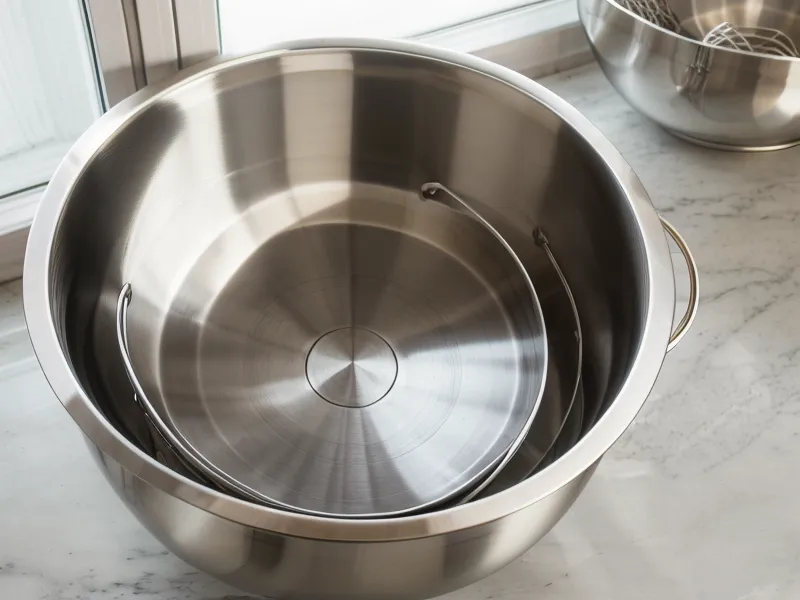
That composition question gets answered in about one sentence, though, because it's not actually what separates a bowl that stays put from one that doesn't. Weight and gauge do that work, and gauge is the number almost nobody puts on the product page.
The Stainless-Steel Gear That Survives Daily Kitchen Prep
Gauge is just a measurement of how thick the sheet metal is before it gets stamped into a bowl shape, and lower numbers mean thicker steel — 18-gauge is noticeably heftier than 22-gauge, which sounds backward the first time you hear it. A thin-gauge bowl is light enough to nest ten deep in a cabinet, which is exactly why so many 'professional' sets go that route: it photographs well and ships cheap. Put a stiff cookie dough or a couple pounds of bread flour into one, though, and it flexes under a wooden spoon in a way that heavier stainless never does.
Heavier bowls with a wide, flared rim and a non-skid or weighted base are the actual fix for a bowl that skates (a rubber shelf liner underneath works for about a week before it goes gummy and needs replacing). My KitchenAid Pro 5 Plus bowl is the extreme version of this: 25 pounds of mixer plus a bowl-lift design that isn't going anywhere no matter how stiff the dough gets, though that's obviously overkill if all you need is something for tossing a salad.
None of this matters if the bowl gets crowded off the counter before you even start mixing, and that's usually a space problem more than a bowl problem. My Vitamix takes up a permanent spot for smoothies and soups, and whatever prep happens next has to share the counter with it — one more reason the base of a bowl needs to grip on its own instead of needing a clear runway to sit still.
Heavier Isn't Automatically Better
There's a point where more weight stops helping and just becomes annoying to wash and store, and most home cooks who bake maybe twice a month never get near it. Where the extra mass genuinely earns its keep is in even heat and pressure distribution, and I notice it most outside of bowls entirely — when I'm pushing a diced onion across my All-Clad skillet and it slides in one even layer from edge to edge with no single spot that scorches ahead of the rest. Thinner gauge metal doesn't do that; it develops a hot ring right over the burner and stays cold everywhere else. A mixing bowl doesn't heat the way a skillet does, obviously, but the same manufacturing quality that keeps a pan's heat even is usually what keeps a bowl's base flat and its rim from warping after a few years of use.
Worth doing before you buy, not after: pick the bowl up and knock a metal whisk against the side. There's a particular thin ring a cold All-Clad pan makes the instant it touches a gas burner grate before it's warmed through, and stainless bowls do a version of the same thing — a higher, thinner note on cheap gauge, a duller thud on the heavy stuff. I did exactly that at the Williams-Sonoma in West Towne Mall a few months back, picking up four different bowls just to feel where the weight sat and whether the rim flexed under my thumb, and the sound told me more than the price tag did.
Steel Isn't Always the Right Call for Home Baking Tools
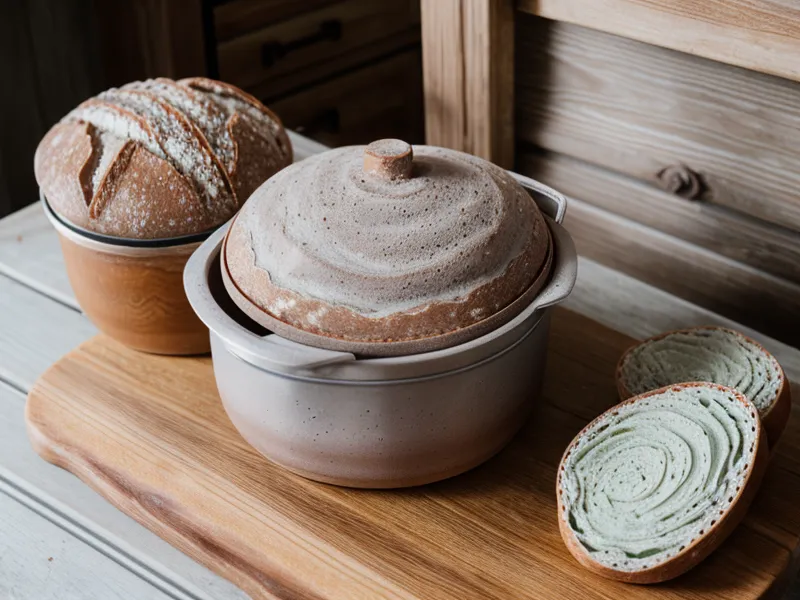
Stainless earns its keep for the fast stuff — salad tossing, egg wash, marinating — but it's a poor choice anywhere temperature stability actually matters, because metal transfers heat and cold too efficiently to hold a steady environment for long. That's the gap the Magnifique 4-quart Claypot fills in my rotation: kaolin clay resists temperature swings in a way sheet metal can't, which matters most for a slow dough rise in a house with drafty windows. It isn't induction-compatible, so anyone on an induction cooktop can cross it off the list immediately, and it's heavier and more breakable than steel, which makes it a complement to a stainless set rather than a replacement for one.
Matching the Bowl to the Rest of Your Lineup
Not every upgrade purchase earns its keep, and it's worth saying so before this turns into an unbroken string of recommendations. I bought a loaf pan a while back — thin-walled, marketed as commercial-grade — that buckled along its seam after about eight months of weekly sourdough, right where the sides meet the base. It looked fine in the store and felt fine in my hand, and it turned out to be money spent on marketing language rather than actual thickness of metal, which is the same test I now run on every prep bowl before it earns a permanent spot in the cabinet.
A stable bowl matters more once you factor in what's happening around it. My Best Professional Chef Knife for Home Cooks Who Prep Daily guide gets into edge retention on its own terms, but the short version is that a knife working through a mound of vegetables needs a surface underneath it that isn't sliding, whether that's a cutting board or the mixing bowl catching the scraps. And once dough actually makes it out of the bowl and into a loaf, the Challenger Breadware pan is where I've landed for the final bake — a different piece of equipment solving a different part of the same process.
The Buy-or-Skip Call for Heavy-Duty Bowls
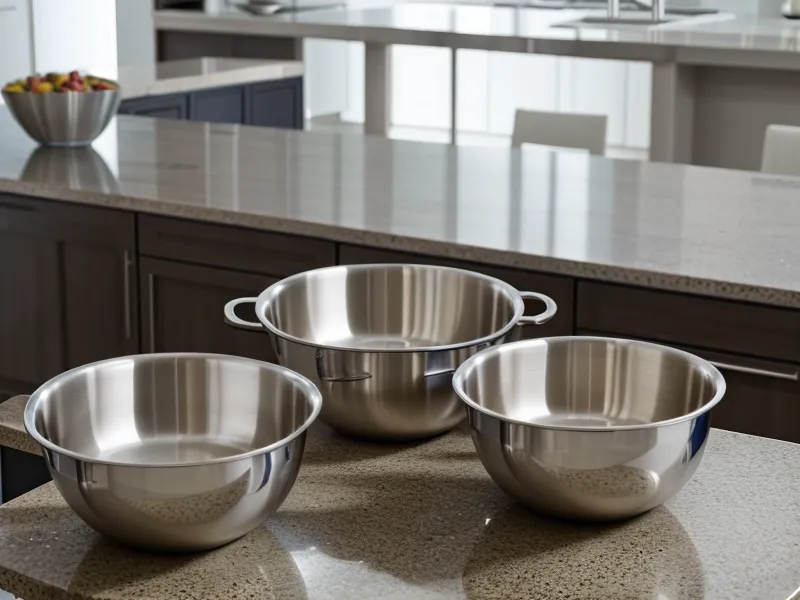
My neighbor Marlo reads this site and has a habit of showing up at my door with a phone screen already open to a product page, asking some version of whether it's actually worth the money. That's more or less the question this whole piece is answering: if you're cooking dinner from scratch most nights, or baking on any kind of regular schedule, the heavier stainless set pays for itself in a couple of years just in the amount of patience it saves you. If you bake once a month and mostly use bowls for tossing salad or holding leftovers, a lighter, cheaper set does the job fine, and the extra weight just becomes dead cabinet space.
I ran this by my neighbor Tess, who bakes seriously most weeks but isn't the type to own six sizes of the same pot, and her answer was the honest one: she wouldn't replace a set that's still working for something heavier just because it exists. That's the actual filter after six years of buying, returning, and rebuying kitchen gear — the upgrade only makes sense once the thing you already own has genuinely let you down, not before.
If you're rounding out a prep station rather than starting from zero, the stainless bowls are the easy first purchase — reliable, dishwasher-safe, and not going anywhere once you've got the right gauge. Pair them with a stand mixer that can actually handle stiff dough and a blender that keeps up with daily use, and check my How to Choose the Right Vitamix Container for Your Blender Model guide next if the wet-prep side of your kitchen still needs sorting out. The comparison table below has current ratings and links for everything mentioned here, in case you want to go straight to the numbers.
| Product | Rating | |
|---|---|---|
| Magnifique Claypot Worth Trying | 8.9 | Read More → |
| All-Clad D3 Stainless | 8.7 | Read More → |
| KitchenAid Pro 5 Plus | 8.5 | Read More → |
| Vitamix Ascent | 9.1 | Read More → |
| Challenger Breadware | 8.3 | Read More → |
Magnifique
Pros
- ● Superior heat and moisture retention for dough proofing
- ● Kaolin clay construction handles high-heat stovetop-to-oven transitions
- ● Natural moisture control prevents dough from skinning over during rises
- ● Beautiful enough to go straight from the oven to the dinner table
Cons
- ✘ Not compatible with induction cooktops
- ✘ Heavier and more fragile than 18/10 stainless steel