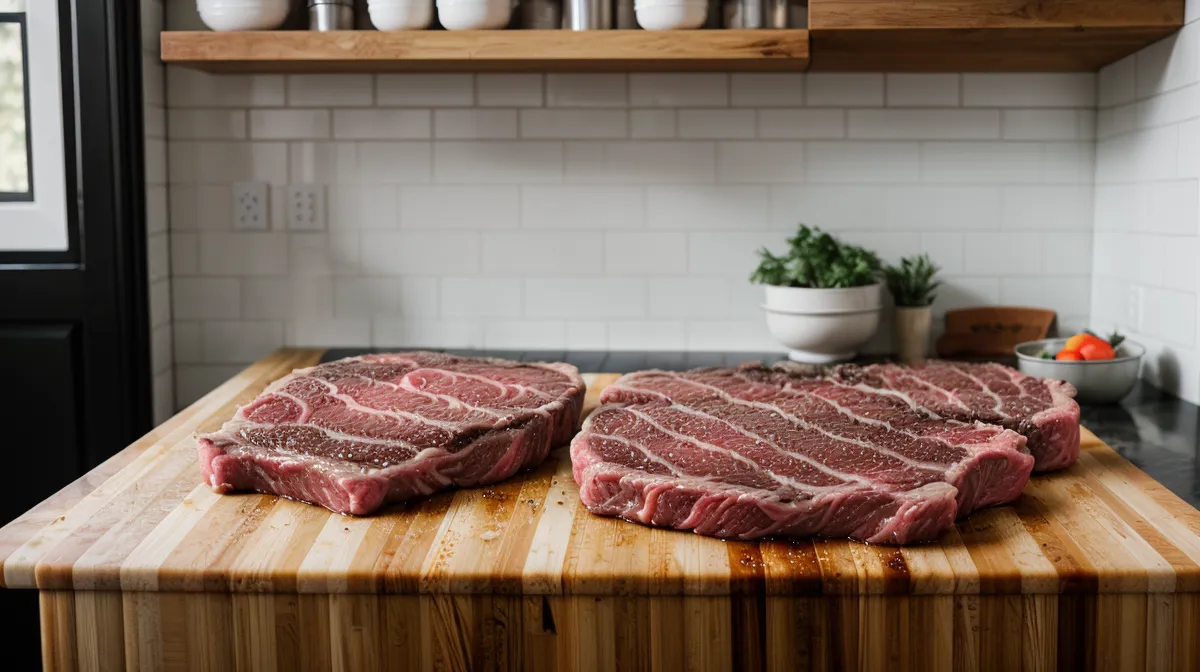
A wireless probe left in a ribeye reports two numbers at once, and only one of them tells you when to actually pull a steak off the grill. That distinction is the entire argument for a smart kitchen tech tool built for grilling, like the Meater 2 Plus, measured head-to-head against the instant-read thermometer it's meant to replace — same steaks, same grill, two different ways of tracking doneness. Steak cooking punishes guesswork more than almost anything else I test gear for; the margin between rare and gray sits inside a handful of degrees, not minutes, which makes this less a gadget review than a real comparison of habits.
Two Ways to Know When a Steak Is Done
Two very different habits, one identical goal. On one side, a probe you insert once, leave alone, and read from a phone across the yard. On the other, a metal spike you jab into the meat every few minutes, popping the grill lid each time to get a number that's already going stale by the time the lid closes again. Every time that lid comes up, the convection environment you spent time building leaks out into the yard, and the grill has to fight its way back to temperature before it resumes cooking the way you intended.
The hardware itself doesn't feel like a toy. The Meater probe is thin (about the width of a wooden skewer) but sturdy, and it's rated to handle ambient heat well past what most home thermometers claim to survive, which matters more over charcoal or a ripping-hot sear than any spec sheet suggests. The real learning curve isn't the hardware, though — it's the setup, including a safety notch etched into the shaft. Push the probe in short of that line and the app will throw an error before the meat even hits the grate, a fail-safe that actually works as long as you're paying attention to it.
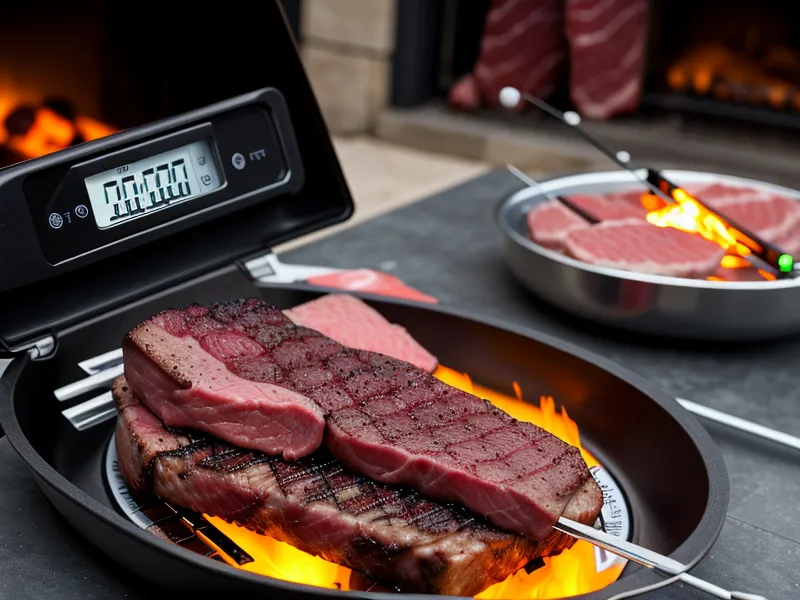
The Wireless Probe Solves the Lid-Lifting Problem
What the Meater actually changes is simple: the grill stays closed. The probe tracks internal and ambient temperature continuously and sends both to a phone, so there's no reason to lift anything just to check on dinner. On a ripping-hot grill, the gap between rare and gray is a matter of degrees, so the real skill isn't poking the meat more often — it's reading the carryover correctly and pulling the steak early enough that residual heat lands it exactly where you wanted. The app's resting phase is really just tracking carryover cooking: once a steak comes off the grate, the heat still sitting in the crust keeps pushing toward the center, and a probe that's still inside the meat can watch that happen instead of you guessing when it's over.
A friend of mine, Audrey, who designs gardens for a living and owns almost no kitchen gear of her own, watched the charging block light up on my counter once and asked if it was a coffee thing. It isn't, obviously, but the mix-up made a point worth keeping: a tool this specific only earns its place once you're already cooking cuts worth worrying about. The clearest proof that precision gear can pay off happened at the stove, not the grill — a pan of sliced onions sliding edge to edge across an All-Clad skillet without ever bunching into one scorched corner, which is exactly what a fully clad steel base is supposed to do and what my old pan quietly never managed.
When Thin Cuts Don't Need a Wireless Probe
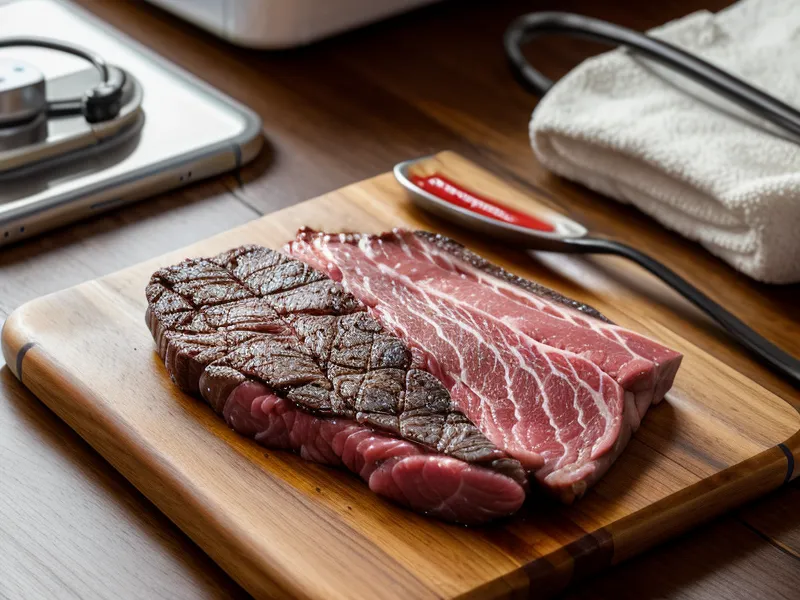
Not every piece of gear I've brought into this kitchen earned its keep. A cheap hand blender I bought on a whim stalled out every time I tried to add frozen mango, and it sits in a drawer now as a reminder that a tool only pays for itself if it solves a problem you actually have. The Meater can fail that same test for a certain kind of cook. A flank steak or a skirt steak is thin enough that probe placement barely matters — the whole cut cooks through in a few minutes, and the difference between a quick instant-read check and a continuous wireless read is negligible.
Burgers and hot dogs don't need it either. Your eyes and a few seconds with a cheap spot thermometer will tell you everything worth knowing, and pairing a phone app with a backyard cookout for ground beef is solving a problem that was never really there. The Meater is built for thick cuts where a few degrees of error actually shows up on the plate, not for food that's forgiving by design.
Placing the Probe Where the Heat Arrives Last
Buying good steaks matters as much as reading them right. Most of what lands on my grill comes from a vendor at the Dane County Farmers' Market at Capitol Square on a Saturday morning, and a well-marbled steak from that stall behaves differently under a probe than a lean cut from a grocery case.
Placement is where most people get it wrong, no matter which thermometer they're holding. The instinct is to aim for the thickest part of the cut, but on an uneven piece of meat, that thickest point is sometimes a dense muscle knot that holds heat differently than the tissue around it — so the spot that actually finishes last, the true center of doneness, sits somewhere else entirely. Whichever thermometer is in your hand, wireless or spot-check, the number it gives you is only as good as where you put it.
Which Thermometer Belongs in Your Kitchen
I still keep the charging block right next to my knives, mostly out of habit. If you've seen my notes on the Best Magnetic Knife Holder for Kitchen Walls After Long-Term Testing, you already know I'm particular about keeping tools where I'll actually grab them. The Meater is dishwasher safe, which helps, though I still hand-wash the probe itself, because a speck of grease left on the magnetic contacts is enough to keep it from charging overnight — which is exactly how I once reached for it before a cook and found it completely dead.
Buy the Meater if you're the kind of cook who spends real money on a thick cut and then can't relax until it's off the grill. It's built for exactly that anxiety, and it's genuinely good at solving it once the setup clicks — including that safety notch, which I ignored once mid-cook and paid for with an error message before the meat had even hit the grate.
Skip it if burgers, hot dogs, and thin cuts make up most of what lands on your grill. A decent instant-read handles that job without an app, a charging dock, or anything to remember to plug in, and a wireless probe on a burger is more gadget than the task calls for. This isn't a tool for cooking better across the board — it's a tool for one specific problem, thick cuts and a distracted host, and it solves that problem better than anything else in a kitchen built around testing gear like this.