The steak hits the pan and the sound is wrong immediately. A thin hiss instead of a roar, gone before I can reach for the tongs. By the time I flip it, what should be a deep mahogany crust looks closer to the color of a mushroom, and I already know the problem isn't the meat. It's the pan. That's my short answer to almost every version of the searing question I hear from readers stepping up from a starter cookware set: stainless steel frying pans earn their reputation because of what happens, or doesn't happen, in that first ninety seconds, and no amount of technique fixes a pan that can't hold its heat.
Getting an actual crust instead of steamed grey meat comes down to a narrow temperature window. The pan surface needs to sit somewhere around 285 to 330 degrees Fahrenheit long enough to trigger the Maillard reaction, and a thin, disc-bottomed pan — the kind that shows up in every big-box starter set — can't hold that line. Drop cold meat onto it and the surface temperature craters before the crust has a chance to start. I owned that exact pan and blamed the meat, the oil, even my own timing, before I figured out the equipment was the actual problem. A cheap pan doesn't announce itself as the culprit; it just quietly ruins dinner and lets you take the blame.
Do You Actually Need a 5-Ply Pan to Sear Well?
No, not for searing specifically, and that surprises people who assume more metal automatically means a better pan. The D3 and D5 differ in exactly how many layers go into the base, which is its own rabbit hole I already went down in How to Choose Between All Clad D3 and D5 Cookware for Your Kitchen. What matters here is simpler: more mass means more heat retention, and retention isn't the same as responsiveness. The heavier pan spreads heat so evenly that finding a hot spot is nearly impossible, which is genuinely useful for a delicate sauce. It's a lot less useful when you want the surface to get screaming hot, do its job in a few minutes, and then let you back off before the inside of a chicken thigh overcooks under a beautiful crust.
Thinner, not thicker. That's the part that trips up anyone shopping by weight, assuming the heavier pan in their hands has to be the better one, and for some jobs it is. For a hard sear, though, a lighter three-ply pan responds to burner adjustments almost instantly, while a heavier one noticeably lags behind, whether you're cranking the heat up or trying to pull it back before the interior overcooks.
The Water Bead Test: How You Know a Pan Is Actually Ready
Heat is only half the problem. Knowing when the pan is actually ready to receive food is the other half, and it trips up more home cooks than the pan itself does. Add oil too early and it smokes; add it too late and the meat sticks before a crust forms. The fix, for me, was learning to spot the Leidenfrost Effect, though I just think of it as the water bead test.
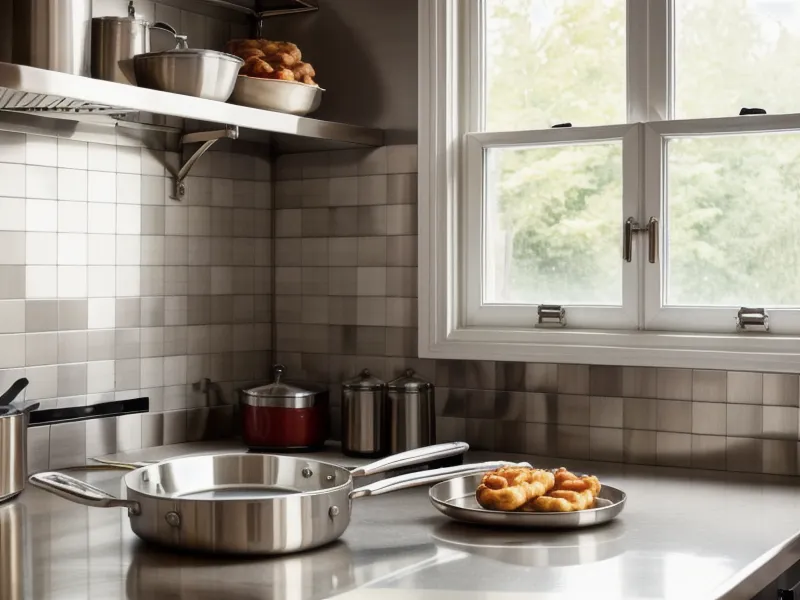
Flick a few drops of water into a properly heated pan and they won't hiss into steam. They'll gather into a bead and skitter across the surface like mercury, riding a thin cushion of their own vapor. Watch that happen once and the guesswork mostly disappears. A pan isn't being difficult when food sticks to it early on; it's just not ready yet, and forcing a flip before it releases on its own is how a beautiful piece of salmon skin ends up shredded in the pan instead of golden and intact. I've done that exact thing, standing at the stove wondering why dinner had turned into salmon salad instead of the crispy-skinned fillet I'd planned.
That same instinct shows up everywhere in a kitchen once you start paying attention to it. You can feel the moment a knife is actually sharp, gliding through a ripe tomato on nothing but its own weight instead of a sawing motion, and a pan behaves no differently — it tells you what it needs if you slow down enough to notice, whether that's more heat, less oil, or just another thirty seconds before the food goes in.
Stainless Steel Versus the Budget Alternatives
Whether you need the full-price All-Clad name on the box is a fair question, and it doesn't have one universal answer. Plenty of budget stainless pans use the same basic idea, an aluminum or copper core clad between layers of steel, and get close enough for a home cook searing a couple of times a week. Where they tend to fall short isn't the sear itself; it's the handle that heats up, the rivets that loosen, the base that warps slightly after enough runs at high heat. I tested the pricier Copper Core line too, and the extra responsiveness is real, but not enough to change my answer for most people. The D3 stays the sweet spot where price meets performance, which is more or less the whole argument behind The Long Game: Why All-Clad D3 Still Claims My Front Burners After Two Years of Daily Testing.
Cut quality matters just as much as pan choice, and it's easy to overlook. Most of the chicken thighs and steaks that end up in my testing come from vendors at the Dane County Farmers' Market at Capitol Square rather than a shrink-wrapped grocery case, and a thicker, evenly trimmed cut sears more predictably than a thin, uneven one no matter which pan is underneath it. Buy an oddly shaped, thin-cut piece of meat and even the best pan in the world will give you an uneven crust.
Who Should Buy an All-Clad Searing Pan — and Who Shouldn't
If you cook at home most nights and want to get serious about a pan sauce, the 12-inch D3 is still the workhorse I'd point you toward. It's light enough to toss a pan of vegetables with one hand but substantial enough to feel like a real tool, and it rewards someone who wants to stand at the stove and pay attention rather than set a timer and walk away.
My friend Audrey Cantwell is the clearest 'don't bother' case I know. She's spent this year training for the Ironman Wisconsin triathlon, and her actual kitchen needs are speed and volume, not a hard sear timed to the minute. She owns almost no cookware of her own; when she wants to bake around the holidays she borrows my KitchenAid rather than buy one. Handing her a pan that punishes you for walking away from the stove for thirty seconds would be a bad trade for someone who's reasonably more focused on her next training block than on building fond.
For poultry especially, I still finish every sear by checking doneness with an instant-read thermometer instead of trusting color alone, which is really its own topic, but the short version is simple: don't skip it. Cleanup is its own trade-off too. Stainless takes a little scrubbing and an occasional pass with a cleaner to stay bright, which is a fair price for a pan that will still be searing dinner long after a nonstick coating has given up and gone dull.
What Ruins a Sear Even With the Right Pan
Not every kitchen upgrade pays off the way the right pan does, which is worth saying before this turns into an argument for buying everything stainless and expensive. A hand blender I bought a while back, a Cuisinart, stalled out every time I tried to add frozen mango to a smoothie, a purchase that looked perfectly reasonable and turned into a waste of a drawer slot. The pan is different. It's one of the rare pieces of gear where the price gap between cheap and good shows up directly in the food, every time, not just on the days you happen to be paying attention.
The pot rack over the butcher block hangs dead center, All-Clad within arm's reach of the stove, and the window over the sink throws the same flat, even light across the counter no matter the season — which matters more than you'd think when you're judging crust color by eye instead of a thermometer. There's a Pyrex bowl that's lived on the counter so long I don't remember deciding to keep it there; it holds the salt I pinch mid-sear without looking away from the pan.
So here's the actual answer: if you sear meat or poultry more than once a week and you're the type who stays at the stove instead of wandering off, buy the D3, or a comparably light three-ply pan from whichever brand fits your budget, and expect it to outlast the trend. If your cooking looks more like Audrey's right now — fast and functional, more focused on getting out the door for a run than on fond — save the money and let a good nonstick or a cast-iron skillet carry you instead. The pan is only worth what it changes about your actual Tuesday night, not what it promises on the box.